There are approximately eight million lists on the internet of the “best art supplies for kids.” This is technically another one.
But I want to talk about something a little different.
Not just what creative supplies we keep around, but why we keep them where kids can actually use them. Because buying good markers and putting them in a closet doesn’t create a creative environment.
Neither does having a cabinet full of craft supplies that only come out when an adult has planned a project. If we want kids to have ideas of their own, they need opportunities to do something with those ideas.
That means having materials around that are easy to see, easy to reach and capable of becoming lots of different things.
And as kids get older, those materials can grow up with them.
This post contains affiliate links. As an Amazon Associate, I earn from qualifying purchases at no additional cost to you. I only recommend products and resources I genuinely use, love, or believe will be helpful.
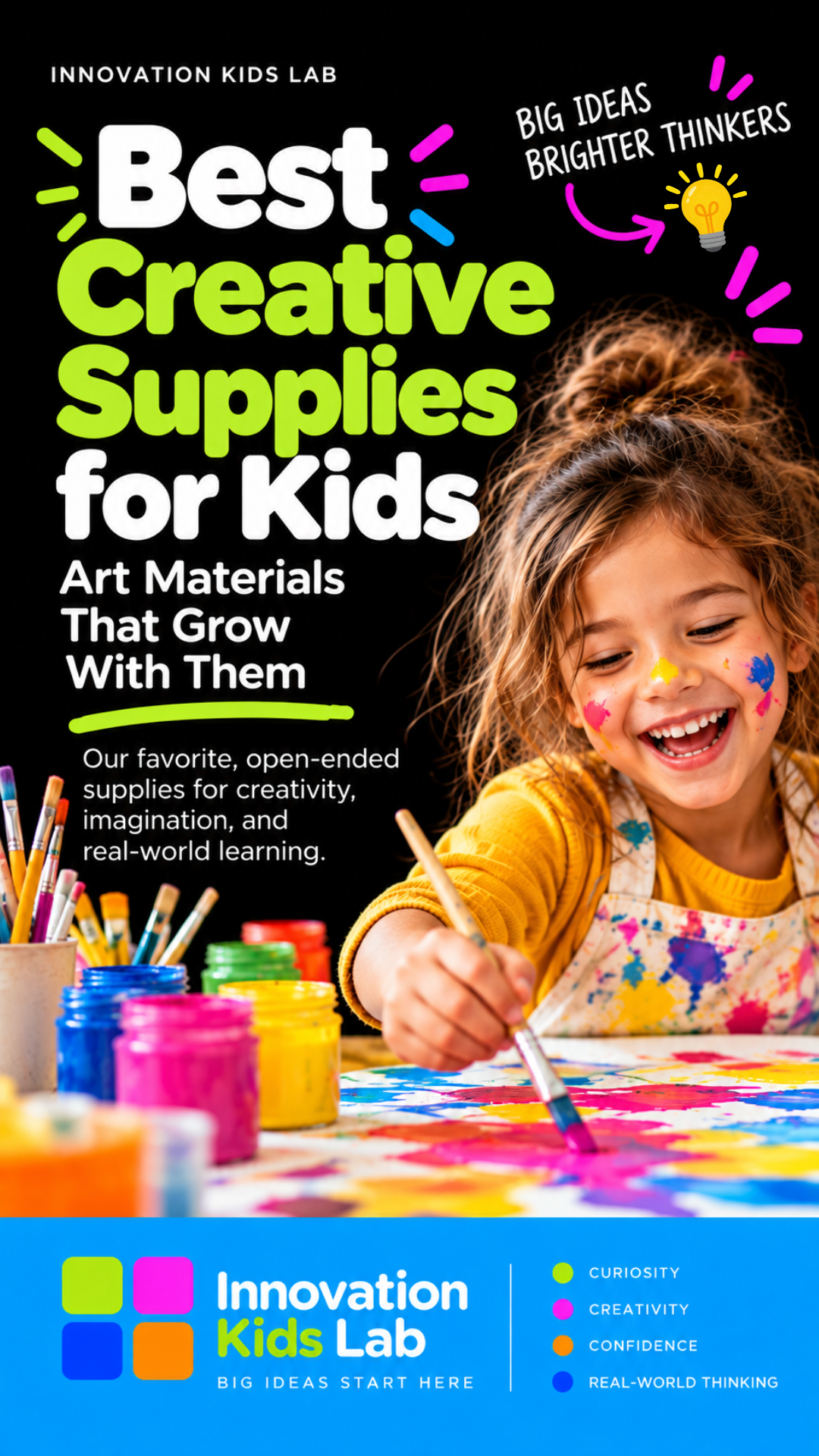
The Best Creative Materials Don’t Tell Kids What to Make
I’ve been looking back through years of Innovation Kids Lab projects lately, and something keeps showing up.
We used the same basic materials again and again. (affiliate links)
Sometimes they became art.
Sometimes they became an engineering challenge.
Sometimes an experiment.
Sometimes a robot.
Sometimes something that would be extremely difficult to explain to another human being.
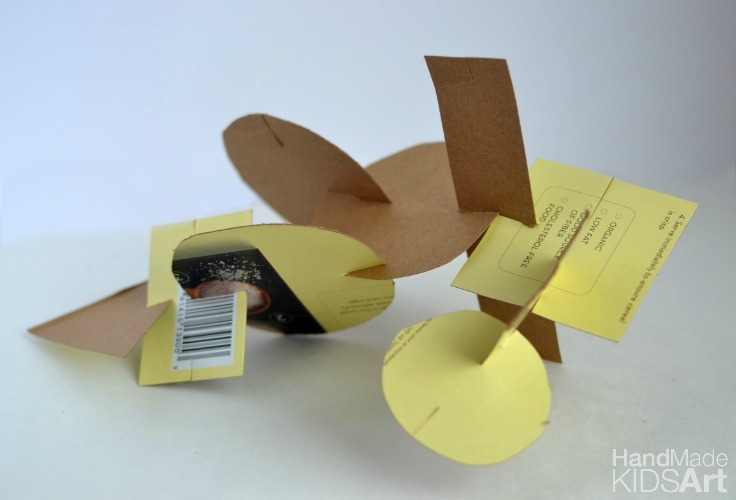
Those might have been my favorites.
That’s what I love about open-ended materials:
They don’t come with an ending.
A kit designed to make one particular thing will probably become that thing.
A cardboard box could become almost anything.
That’s why I’d rather have a small collection of useful creative materials available than a closet full of project-specific kits.
Give kids enough to get started.
Then leave some of the interesting thinking to them.
Start With a Few Really Good Basics
You don’t need an enormous art closet. These are the supplies we’ve reached for again and again at Innovation Kids Lab.
Paper + Cardstock
White paper.
Colored paper.
Cardstock.
Big paper.
Scrap paper.
Paper can become a drawing, plan, prototype, sign, sculpture, game, book, airplane or the beginning of an idea that hasn’t been invented yet.
I like having different sizes and weights available because changing the material can change what kids think to do with it.
Our favorite cardstock paper (affiliate link)
Markers
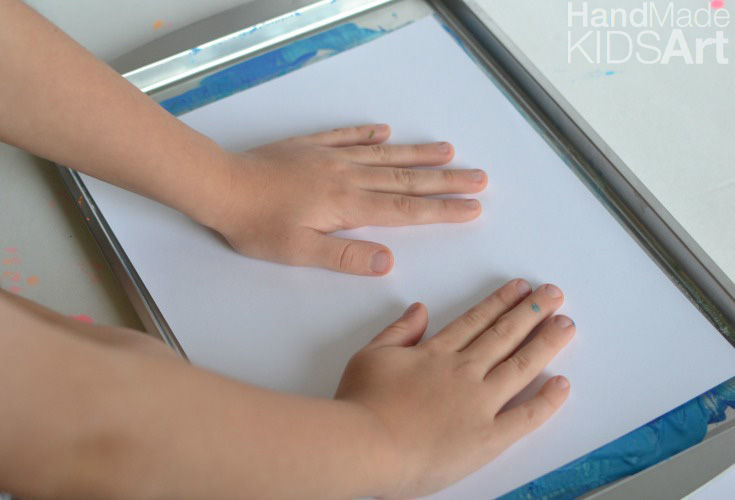
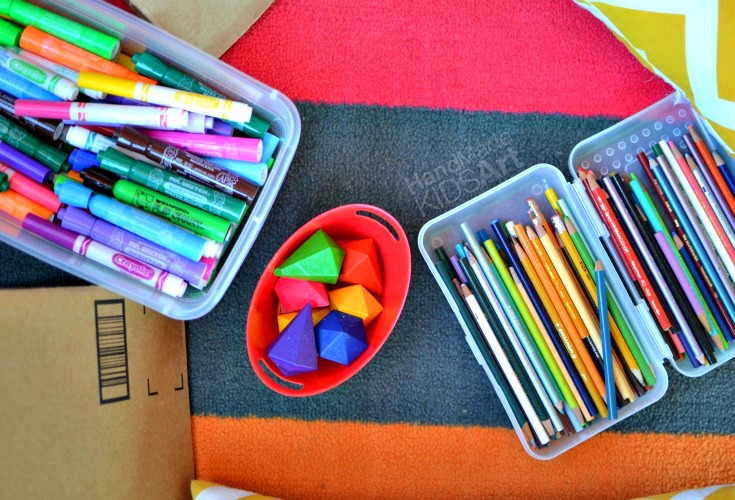
Good markers are one of those supplies I don’t mind buying repeatedly.
We’ve used them for drawing, designing, experimenting and even building Art Bots.
And markers don’t need to be reserved for an official “art project.”
Put markers near paper and see what happens.
Our favorite markers (affiliate link)
Paint
We’ve done a LOT with paint around here.
Pendulum painting. Process art. Force and motion experiments. Painting with unusual tools.
Paint gets especially interesting when the question isn’t:
What picture are we going to paint?
but:
What could we try with this?
We always kept two kinds of paint around: tempera paint and liquid watercolors.
Tempera paint is the workhorse. Painting on cardboard, experimenting with color, big messy projects, printing, building projects that suddenly become painting projects…it works for almost everything.
Our favorite washable tempera paint (affiliate link)
Liquid watercolors were another IKL staple. They’re bright, easy to mix and especially fun for experimenting with color, absorption, droppers and all kinds of art + science investigations.
See our favorite liquid watercolors. (affiliate link)
Paper-backed drop cloth
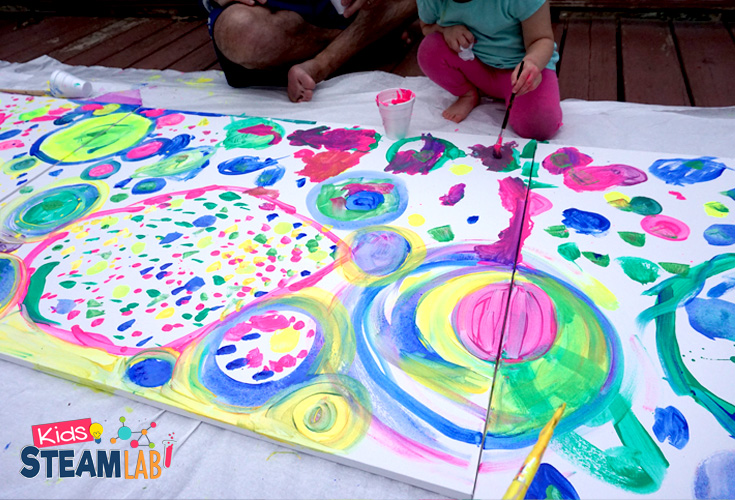
We originally used this to protect tables and floors, but the paper side also makes a giant painting surface. We’ve rolled it out for collaborative murals, and it’s great underneath a painting or making station when you want kids to have plenty of room to work (and you don’t want to worry about the mess).
See our favorite paper-backed drop cloth. (affiliate link)
Tape
If I had to choose one creative supply for kids who like to build, tape would be pretty high on the list.
Cardboard + tape can go a very long way.
Masking tape is easy to tear. Painter’s tape works for temporary construction. Clear tape solves different problems.
As kids get older, stronger tapes can expand what they’re able to build.
Our favorite tape (affiliate link)
Scissors
Scissors aren’t just craft supplies.
They’re tools.
Kids need tools that let them change materials: cut them, combine them, reshape them and turn them into something else.
Start with age-appropriate scissors and let the tools grow with the kid.
Our favorite scissors (affiliate link)
Glue
Glue sticks are easy.
Liquid glue opens up other possibilities.
And as kids get older and their projects become more ambitious, they may be ready for tools that create stronger connections.
We’ll get to that in a minute.
Our favorite glue (affiliate link)
String, Yarn + Things That Connect
String doesn’t look terribly exciting sitting in a basket.
Until someone needs to hang something, connect something, pull something, test something, build something or invent something.
Those are exactly the kinds of materials I like having around.
They solve lots of different problems instead of prescribing one project.
Our favorite string (affiliate link)
Before You Buy Anything, Check Your Recycling Bin
Seriously.
Some of our favorite creative materials have always been free.
Keep a spot for things like cardboard boxes, paper tubes, clean containers, bottle caps, interesting packaging, fabric scraps, ribbon, old magazines, leftover paper and bits from previous projects.
You don’t need to keep every cereal box your family encounters until your house begins to resemble a recycling facility.
Ask me how I know.
Keep a manageable collection of things that have possibility.
Then let kids actually use them.
The Part We Sometimes Miss: Kids Need to See the Materials
A creative supply hidden in a closet is very different from a creative supply sitting where someone can notice it.
That doesn’t mean your entire house has to become an art studio.
But think about how you arrange materials.
Could paper sit next to markers?
Could cardboard pieces live in a basket?
Could tape, scissors and string share a container?
Could you occasionally arrange a few interesting materials on a table without providing instructions for what to make?
We tend to understand this naturally with young children.
We arrange blocks invitingly.
We put crayons beside paper.
We set out play dough with a few tools.
The environment quietly says:
You can do something here.
But then kids get older.
The toys disappear. The art supplies move into a cabinet. The table fills up with homework, devices and activities that already have predetermined outcomes.
And somehow we stop creating spaces that invite them to create.
Kids Don’t Outgrow Creativity. The Materials Grow Up.
A ten-year-old might not be especially inspired by the preschool art cart.
A fourteen-year-old almost certainly isn’t going to come running because you’ve arranged pom-poms and googly eyes in a muffin tin.
That doesn’t mean they’ve outgrown making.
Maybe the materials need to grow up with them.
- Cardboard.
- Foam board.
- Wire.
- Fabric.
- Better drawing tools.
- A cutting mat.
- A ruler.
- Fasteners.
- Small hardware.
- Electronics.
- Real tools, introduced appropriately as kids develop the skills to use them safely.
Instead of asking:
What craft should we do?
we can start asking:
What might you need if you wanted to make something?
And that’s where I love the idea of a Creator Cart.
Let the Art Cart Grow Into a Creator Cart
Years ago, we had a STEAM cart at Innovation Kids Lab.
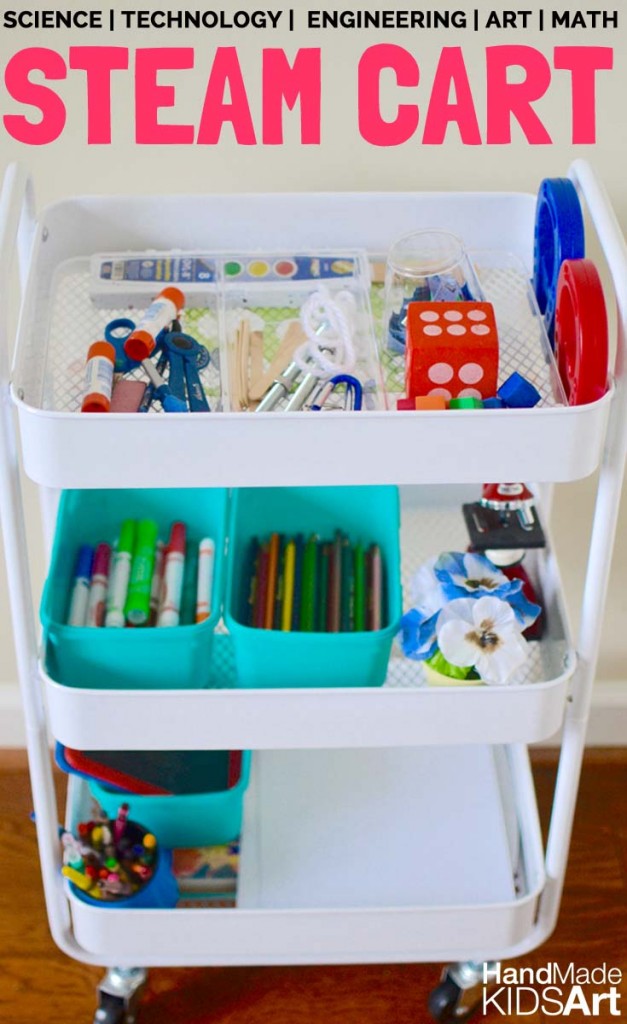
Looking back, what I like most about the idea isn’t actually the STEM part.
It’s the access.
Kids didn’t have to wait for an adult to announce that it was time to be creative.
Materials were there.
So instead of getting rid of the art cart as kids get older, what if we let it grow up with them?
The crayons and glue sticks don’t necessarily disappear.
We just start adding materials and tools that match what our kids are capable of doing now.
The art cart becomes a Creator Cart.
Not because we need another perfectly organized cart with matching labels.
Please do not let this article send you to the Container Store for three hours. 😂
The point is much simpler:
Give kids access to useful materials when they have an idea of their own.
What Goes on a Creator Cart?
I wouldn’t start by buying everything.
I’d think in categories.
Something to create with
Paper. Cardstock. Cardboard. Foam board. Fabric. Wood scraps or other age-appropriate building materials.
Something to connect with
Tape. Glue. String. Yarn. Wire. Rubber bands. Clips. Fasteners.
Something to change materials with
Scissors. Rulers. Hole punches. A cutting mat and other age-appropriate tools.
Something to draw, design and plan with
Pencils. Markers. Pens. Graph paper. Sketch paper. Notebooks.
Because creating doesn’t always start by making.
Sometimes it starts by sketching a ridiculous idea on the back of a piece of paper.
Something interesting
This might be my favorite category.
Wheels. Corks. Bottle caps. Magnets. Small hardware. Craft sticks. Fabric scraps. Interesting recyclables.
Things that make a kid pick something up and wonder:
What could I do with this?
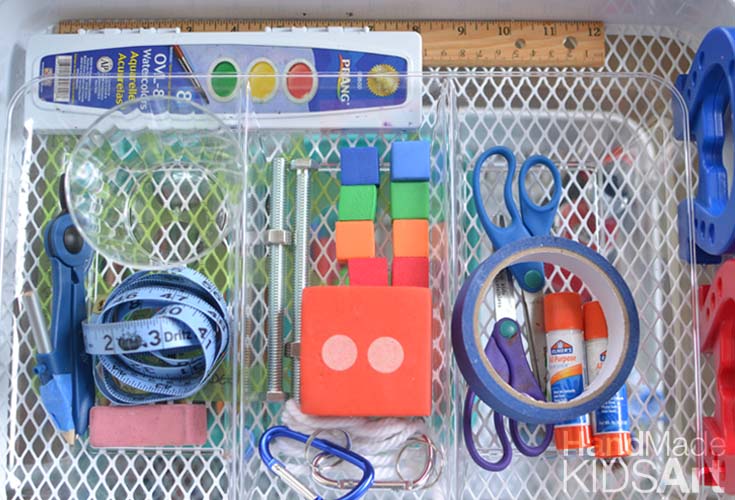
Over the years we’ve used a variety of carts.
Here are two our favorite carts.
And Yes, Eventually That Might Include a Hot Glue Gun
As kids get older, their ideas get more ambitious.
The tools can too.
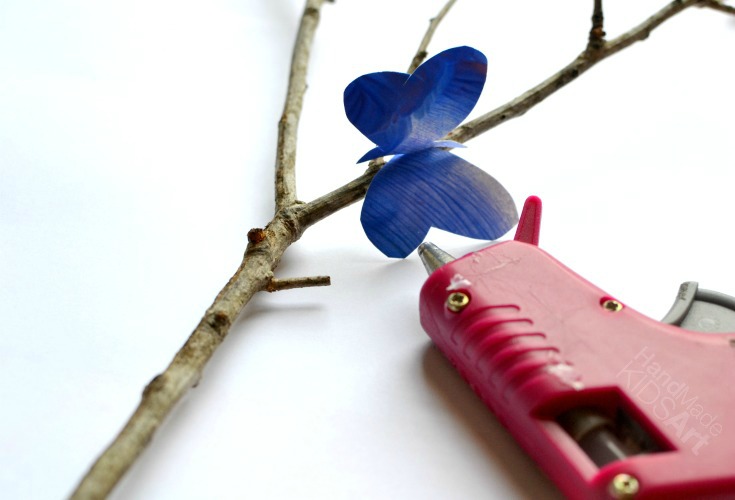
For a child who’s ready to learn to use one safely, a hot glue gun can completely change what they’re able to build with cardboard and other materials.
Instead of an adult doing all the “real” construction, kids can gradually learn to use real tools themselves with the supervision appropriate for their age, experience and the tool.
That’s part of creating too.
Learning how a tool works.
Learning what it can do.
Learning how to use it responsibly.
Real creative independence requires more than access to materials.
It also requires skills.
We like a cool temp hot glue gun like this one. (affiliate link)
Don’t Stock the Perfect Creator Cart
This is where I am going to save both of us from ourselves.
You do not need to Google, “ULTIMATE CREATOR CART SUPPLY LIST” and buy 47 things.
Start with what you already have.
Then watch.
- What does your kid keep making?
- What material do they keep asking for?
- What can’t they do yet because they don’t have the right tool?
- What are they curious about?
Add things in response to what they’re actually doing. A kid who suddenly wants to sew needs different materials than a kid building cardboard arcade games. A kid drawing comics needs different tools than a kid obsessed with taking electronics apart.
The Creator Cart doesn’t need to look the same in every house.
Actually, it probably shouldn’t.
It can become a reflection of the kid using it.
Then Comes the Hard Part: Don’t Tell Them What to Make
This is where all those supplies connect to what we care about most at Innovation Kids Lab. Because the materials aren’t really the activity.
The thinking is.
You can put cardboard, tape, scissors and markers on the table and immediately say:
“Let’s make a castle! Here, I’ll show you.”
Or you can say:
“I put some materials out if you feel like making something.”
You can offer a challenge:
Could you build something that moves?
You can wonder aloud:
What could you make with that box?
You can ask:
What else would you need to make your idea work?
And then…
you can stop talking.
That last part can be surprisingly difficult. Kids don’t always need us to supply the idea. Sometimes our job is to create the conditions in which an idea can happen.
Creativity Doesn’t Need to End When Childhood Crafts Do
I don’t think the goal is to raise kids who complete a lot of projects.
I want kids to know what it feels like to have an idea and think:
- I could try that.
- To look around for what they need.
- To begin without knowing exactly how it will turn out.
- To run into a problem.
- To change something.
- To try again.
And eventually to look at something that didn’t exist before and know:
I made that from an idea I had.
That’s why we keep creative materials around. Not because every afternoon needs an activity. Not because kids need more stuff.
And definitely not because everything they make needs to be beautiful enough to photograph.
We keep materials around because:
Ideas need somewhere to go.
Give kids useful materials. Keep them within reach.
Let the tools grow up with them. And when an idea appears, give them some room to see where it goes.
Big ideas start here.


Leave a Reply