I love school supply season.
I loved it as a kid, I loved it as a teacher, and I still love it now. There is something about cracking open a brand new notebook. Brand new crayons. Markers that haven’t dried out yet. That first clean page.
So you go get the school supply list. The four folders in four specific colors, the wide-ruled composition books, the glue sticks, the pencil box. You check every line off.
Here’s the thing I want you to notice this year.
Every single one of those notebooks already has an assignment waiting in it.
The composition book is for spelling.
The folder is for math worksheets.
All of it is good stuff. But none of it belongs to your kid. Not really.
Every page is waiting for a right answer.
So this year, buy one extra notebook or composition book.
Not for the supply list. Not for school.
But one extra notebook that never leaves the house and never gets an assignment. Let your child pick it, and let it be the ridiculous one with the holographic cover, because the whole point is that this one is theirs.
This is the wonder notebook.
It’s the only book they own where there’s no such thing as a wrong answer, where nobody grades it and It’s where all the questions they can’t ask at school get to live.
That’s the whole idea. Now here’s the part that makes or breaks it.

Here’s the part nobody tells you
You cannot hand a kid a blank notebook and say “this is for your ideas.”
I know, because I tried a version of it on my very first day of teaching. First class I ever taught, fifth grade. I gave them a wide open drawing prompt, the kind meant to be freeing, so I could get to know them a little.
They sat there. Frozen.
I thought they hadn’t understood me, so I said it again. And a boy in the front row finally said:
“Mrs. Hand, we understand the directions. But what do you want us to draw?”
That was the moment everything changed for me.
A blank page is not freedom for a kid who has been trained to wait for directions. It’s a test they don’t know how to pass. Hand a brand new notebook to your eight year old and say “put your ideas in it,” and there’s a real chance it sits on the shelf, perfect and empty, all year.
So we don’t start with a blank page.
We start with page one.
This week’s Innovation Challenge
Sit down together at the kitchen table. You write the three prompts, in your handwriting, spread across the first couple of pages. Then you ask them out loud.
My favorite things. Fill the whole page.
What I know about them.
What I still have questions about.
That’s it. Ten minutes.
Notice the third one. Not “what do you want to learn about,” which sounds like homework and earns you a shrug. What do you still have questions about. It assumes your kid already knows a lot, which for a seven year old deep in sharks or Squishmallows or the Titanic is completely true. And being treated like the expert is what opens them up.
Your kid answers all three. In their handwriting. Misspellings and all. Or if they are younger they dicate to you and you write. They also could draw too!
I have proof this works
When my kids were young, I had an easel set up in our house.
One column per kid. At the top, their thing. One column said trains. The other said ponies. Underneath, everything they knew about it. And at the bottom, in their own wobbly handwriting, their own questions.
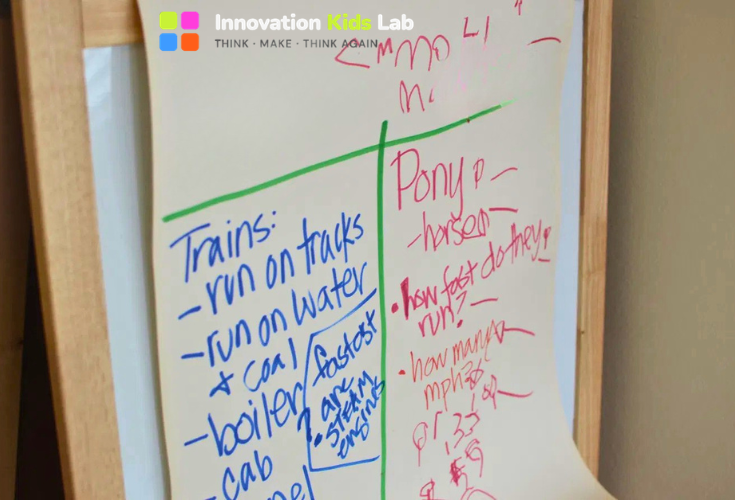
How fast do they run? How many mph?
I still have the picture.
That easel chart turned into library books. It turned into little invitations to play, trains and ponies set out on the table in the morning. It turned into weeks of the same play, going deeper.
I didn’t plan any of it. I just wrote down what they already loved and what they still wondered, and then I followed it.
The notebook is that easel, sized for an older kid, and owned by them instead of by me.
What not to do
When you get to the third question, your kid is probably going to stall.
Every instinct you have is going to tell you to help. To offer something. Well, don’t you wonder how sharks sleep?
Don’t.
Let the silence sit there. That pause is not your kid being stuck. That pause is your kid thinking, probably harder than they’ve had to think all summer, because nobody handed them the answer this time.
Also: it’s their notebook. You don’t correct the spelling, you don’t fix the drawing, you don’t suggest a better favorite thing. The outcome doesn’t matter. It’s the process and the thinking that matter.
It doesn’t stop at page one
Page one is just the doorway, the starting point.
The whole point is that the notebook keeps going. When your kid comes home lit up about something, a bug they found, a fact that broke their brain, a question that popped up at dinner and had nowhere to land, it goes in the notebook.
You don’t have to run a lesson. You just say “put it in your wonder notebook,” and they do.
Some days it’s a drawing. Some days it’s one wobbly sentence. Some days it’s a page of questions with no answers, which is exactly right. By the time the leaves turn, that ridiculous holographic notebook is fat with the record of everything your kid wondered about all fall. In their handwriting. Nobody assigned a word of it.
That’s the thing you can’t buy on the supply list.
Kid-directed learning
Here’s why I want that notebook in your house before school starts.
That third question is a seed.
Somewhere around October, when the newness of school has worn off and you’re staring down a long gray Saturday, you’re going to flip back to page one and read your kid’s own question in your kid’s own handwriting.
And you’ll have something real to build from. A question they actually asked, about a thing they actually love.
That’s a kid-directed project. That’s the whole beginning of one.
It’s the easiest possible way to start, and it costs you a notebook and ten minutes at the kitchen table.
Go let them pick the ridiculous one.


Leave a Reply